There's a version of this post that starts with "We're thrilled to announce." You're not getting that version.
What you're getting is the honest one.
Grant Peterson spent roughly 12 years at Docusign. He watched the eSignature market mature from a genuinely useful technology into something else entirely: a renewal cycle businesses dread, a pricing model that punishes growth, and a product roadmap that stopped serving customers somewhere around the time the stock hit its peak.
That's the market we're entering. Not because it's wide open, but because it's broken in a specific, fixable way.
The problem isn't the product. It's the pricing model.
Most companies using Docusign or Adobe Sign aren't dissatisfied with the signing experience. They're dissatisfied with what they pay for it. When a platform charges per seat and per envelope on top of an annual contract that escalates at renewal, the cost of running a document-heavy operation compounds fast. Construction firms. Credit unions. Insurance agencies. HR teams. These aren't companies processing ten contracts a year.
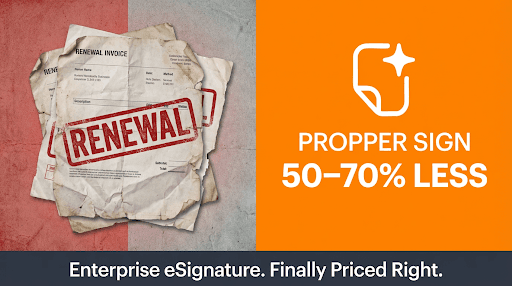
Propper Sign is priced the way software should be: one flat annual plan, 240 included documents a year, and transparent volume discounts on additional documents. No seat fees. No shakedown at renewal. Organizations switching from incumbent providers are landing 50 to 70% lower on total cost, often in the first year.
That's not a promotional claim. That's what happens when you remove the per-seat tax.
The switching problem was always the real moat.
Docusign's stickiest feature wasn't templates or audit trails. It was friction. A decade of templates built in their format, integrations wired to their API, institutional inertia around a product that "mostly works." Switching felt expensive even when the math said otherwise.
Propper Sign supports Docusign template formats natively and drops into existing Docusign API integrations with minimal rework. That was a deliberate engineering decision, not an accident. We wanted the switching cost to be close to zero, so the decision would come down to what it should always come down to: product and price.
Why build on AI architecture now?
The eSignature market was designed before documents could do anything after they were signed. That's not an insult to the category. It's just the historical reality. Agreements lived in filing cabinets, then PDFs, then cloud storage. Static in every case.
Propper Sign is built on a data model where every signed document is structured, machine-readable, and ready for the kind of downstream automation that's becoming table stakes for operations teams. That means customers aren't signing up for a signing tool. They're building on infrastructure that works with what's coming, not against it.
Grant put it plainly: "The market is ready for an intelligent document management solution that is built for AI from the ground up. Companies have been overpaying for eSignature for years."
What's available today
Propper Sign is live. Full enterprise feature set, including custom branding, SSO, multi-party signing, audit trails, and template and API compatibility with Docusign. Business plans run $180 per year. There's a real-time pricing calculator on the site that shows you exactly what you'd pay, and what you'd save, based on your current volume.
No demo required to see the number.
Visit propper.ai to see what your next renewal actually costs →
Read the full press release on EIN Presswire.
A question worth sitting with: If your eSignature renewal came in 60% lower and the product did everything you needed, what would you do with the difference?
Docusign® is a registered trademark of Docusign, Inc. Adobe®, Adobe Sign®, and Acrobat Sign® are registered trademarks of Adobe Inc. Propper® is a registered trademark of PropperDocs, Inc. PropperDocs, Inc. is not affiliated with, endorsed by, or sponsored by Docusign, Inc. or Adobe Inc. References to third-party products are for identification and comparison purposes only.